

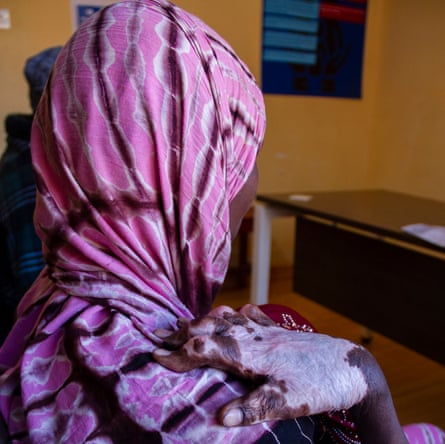
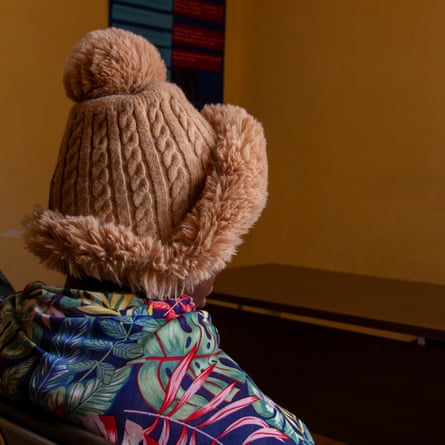
Weeping flows down the refugee’s face as she pulls her glove. Her right hand is marked by a faded, uneven burn scar. Her joints are rigid and misshapen.
She began sex work to make ends meet soon after she came by herself at Malawi’s Dzaleka shelter in 2015, having journeyed there from Burundi.
On the night before Christmas in 2022, a client declined payment. When she obstructed the doorway, he grabbed a scalding saucepan of beans and hurled it at her, injuring her hand and chest.
Life for refugees in Malawi has become more challenging, with budget reductions by international donors resulting in most eating just once a day.
At the same time, the chances of relocation to countries in the west have been lowered from small to unlikely.
I see other people going, who are in good health … I ask myself, ‘Why is it that I don’t get helped like others?’
After being left by her mother, Francine lived in Burundi with an relative involved in politics, who was gunned down in 2014.
Traumatized by her experiences, the young mother of children aged two and nine believes her life would be at risk if she returned to Burundi.
She doubts why she has never been reviewed for transfer.
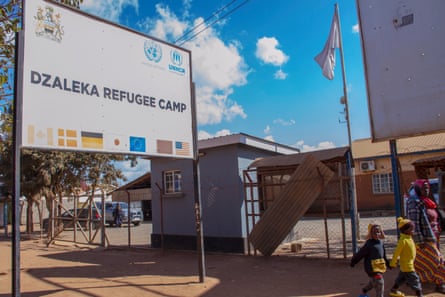
Malawi, one of the world’s least developed countries, has a background of hosting refugees.
Dzaleka camp was built on the edges of the capital, Lilongwe, in 1994. The overcrowded camp, which has become an impoverished area, was intended to host 10,000 people.
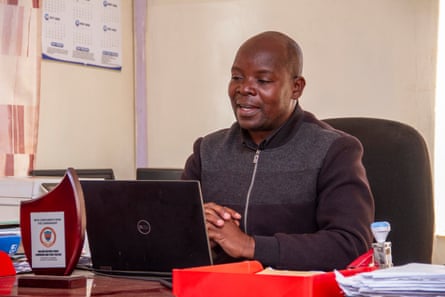
Now, more than 58,000 refugees stay there. About 60% of them are from the Democratic Republic of the Congo (DRC), from where up to 200 more come monthly.
Malawi’s “resettlement law” prevents refugees from staying officially or earning outside Dzaleka, making them especially vulnerable to funding cuts.
Cash payments have been lowered to 50% of what is needed for food.
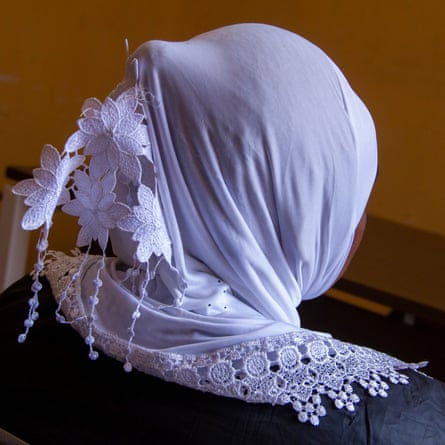
All of the years that we have been here, UNHCR has never thought about us
The budget issues have led to a increase in sex work, domestic violence cases and children taking things.
Anne, a mother of seven, still assists and believes that she sees four to six people of domestic violence a week, double the number of two years ago.
Malawi is looking into building a new camp near the Tanzanian border. However, Anne and other refugees say they want to stay in Dzaleka.
The government is also reviewing changing the law to allow refugees to work outside camps.
Judith fled Lubumbashi in the southern DRC in 2016, after attackers killed her parents. Just 14, she was left looking after her three younger brothers and sisters.
She had to turn to sex work and has a four-year-old child with an man who left.
* Names have been changed to protect their identity

